Skunks and Skunk Removal by Suburban Wildlife Control:
The striped skunk is native to all of Illinois, and has adapted to living life in human environments. They can be found in every city and suburb, although they are often "uninvited guests". Skunks like to take up residency under concrete stoops, decks, porches, sheds, and more. Once they do, you will probably smell them. Skunks discharge an obnoxious scent when provoked. This scent or musk is secreted by two internal glands located at the base of the tail. The glands are exposed when it raises it's tail. A skunk has voluntary control over the glands and can control the direction in which the musk is discharged. The glands contain about one tablespoon of thick, volatile, yellowish, oily liquid. This musk (the chemical name is butylmercaptan) has been detected at distances of up to 20 miles away from where it was discharged. The compound is painful to the eyes, but does not cause permanent blindness. Skunks are slow-moving and docile. Their senses of sight, hearing, and smell are poor compared to many predators. Because of this, skunks may spray their awful smelling "defense" at the slightest threat or annoyance. They are more likely to spray during mating season (when they are fighting for a mate), and if the property owner has dogs or cats that the skunk(s) may see as a threat. Mother skunks are also more easily provoked to spray (to protect young), and invasion of the skunk's territory by other wild animals (opossums, raccoons, etc), will surely cause them to discharge their awful odor. The odor has a tendency to linger, so the sooner the animals are removed, the better. Skunks can also do extensive damage to lawns and turf while searching for insect foods, especially in the fall when grubs are plentiful. Skunk lawn damage can be recognized as many small holes the size of a quarter to a half dollar, which look unsightly on golf courses and residential lawns. Unfortunately skunks are avid carriers of rabies. This can be transmitted to humans and pets, even horses! They may also carry a host of other parasites and diseases including mites, lice, fleas, worms, mange, and distemper. Skunks left living under stoops, etc, can make biohazardous conditions with their urine, feces, illnesses, and habits of eating the carcasses of dead animals. There is only one sure way how to get rid of a skunk or skunks, and that is to have them trapped and taken away professionally. We trap and remove nuisance skunks, and in most cases we can do this without having the animal spray.* Please contact us if you suspect you have a skunk problem. If you are unsure what type of animal is causing your wildlife problem, we will be able to tell you upon our thorough and expert inspection. |
 |
|
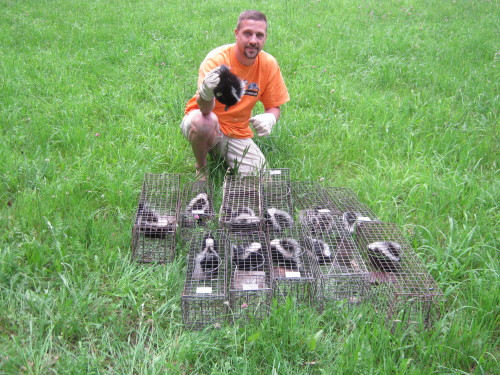
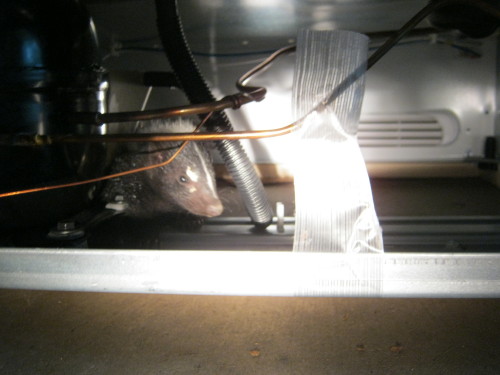
| 12 skunks in one day! (^) and a skunk under a customer's refridgerator (below) | ||
 |
Skunk Spray Smell & Odor:A lot of times the reason we find out we have a skunk living on our property is because they spray, and once they do it's impossible to ignore! Do you need to know how to get rid of skunk spray smell and odor? Although it isn't always possible to get rid of skunk spray that has been discharged in tough to reach places, it is possible to remove skunk spray stench from areas (and things) that can be scrubbed or given a good soaking and rinsing. There is only one method that we are aware of that really, truly works. Please visit our skunk spray smell removal page for complete instructions! Thanks! (click on the underlined link in bold right above) |
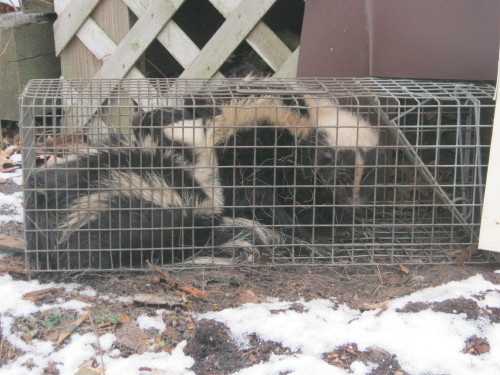 2 skunks in one trap! That doesn't happen very often! These two were stinking up a homeowner's deck, yard, and home. |
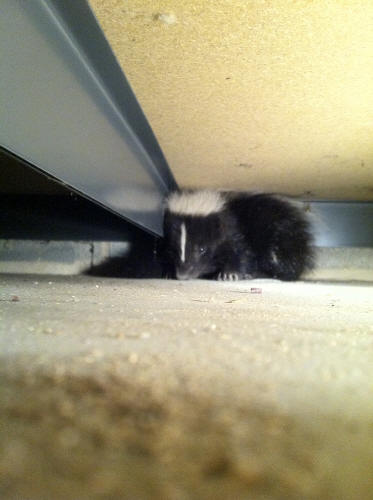
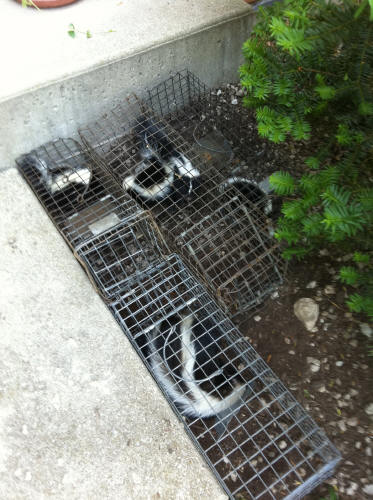
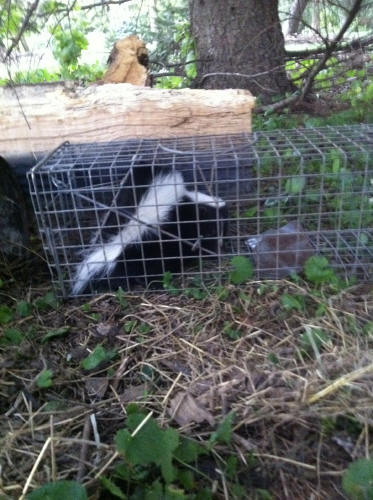
A little skunk that got into a warehouse (left) 5 skunks trapped at one time (including 2 in one trap)
that were living right under their front door (making it hard to leave the house!)(middle)
and a skunk we trapped from a customer's yard that was spraying their dogs. (right)
More photos of Skunks in our Skunk Photo Gallery >
*We are experts at "no-spray skunk removal" as we have many, many years of experience and take the utmost care,
however we can not guarantee that a skunk will not spray upon removal as it is a wild animal and we have no control over its
possible reactions, especially if it has become highly agitated before our arrival due to dogs, people, other animals or
other circumstances. Thank you. :)